Over the past decades, wetland areas across the Middle East have shrunk to a small portion of their original size and risking the habitat essential for supporting vast amount of wildlife and unique human cultures. The Mesopotamian Marshes across Iraq and Iran are experiencing an extreme environmental crisis as a result of purposeful damage to the area during the Hussein regime.
The marshes have started to heal since the deposition of Hussein in 2003 however, they are far from returning to their original size and, despite significant efforts to restore the marshes, there is considerable anxiety that decades of environmental abuse will prevent the marshes from ever returning to their original size.
Wetlands: The Middle East’s Overlooked Lifeline
Wetlands are rarely fairly noted for their essential contributions to maintaining a healthy ecosystem across the region with people normally focusing instead on the protection of rivers and freshwater lakes. Despite this, wetlands provide countless benefits for the regional environment, and their destruction poses significant risk to the overall health of humans and wildlife alike.
Notable wetlands are spread across the MENA region such as Lake Idku in the Egyptian Nile Delta and Al Wathba in the United Arab Emirates but the largest, and most under threat, is the Mesopotamian Marshes that spread across southern Iraq and southwest Iran.
Why Do Wetlands Matter?
Despite their frequent neglection, wetlands are essential to protecting the biodiversity and the climate in a region and often encompass a vast and complex ecosystem that supports the survival of numerous species of plant, wildlife and more.
It is hard to understate the importance of wetlands to local wildlife and species that use wetlands as an important breeding or resting ground during migration. The Ramsar Convention on Wetlands, an international treaty committed to protecting wetlands around the globe, estimate that 40% of the worlds animal and plant species live or breed in wetlands despite only covering roughly 6% of land surface. In addition to this, wetlands support over 100,000 different freshwater species emphasizing the importance of wetlands to global and regional biodiversity.
“Estimate that 40% of the worlds animal and plant species live or breed in wetlands despite only covering roughly 6% of land surface”.
Wetlands also protect and regulate the climate, mitigating the effects of larger changes in the environment and enforce stability in regional climate patterns. In areas where wetlands have been significantly damaged or shrunk, dramatic changes in the climate have been witnessed including more frequent droughts, heatwaves and other extreme weather events.
Wetlands naturally trap and process carbon in the atmosphere at an impressive rate due to the low-oxygen conditions they possess allowing carbon to accumulate and be locked away for centuries. Wetlands actually trap carbon at a much more efficient rate than forests with wetland areas currently storing up to 700 billion tons of carbon offering extremely beneficial carbon sinks that could be essential to future struggles in mitigating the adverse impacts of climate change.
“Wetlands trap carbon at a much more efficient rate than forests with wetland areas currently storing up to 700 billion tons of carbon ,offering beneficial carbon sinks that could be essential to future struggles in mitigating the adverse impacts of climate change”.
However, when these wetlands are damaged, their ability to retain carbon is destroyed, resulting in mass greenhouse gas emissions. In areas, such as southern Iraq, where wetlands have been damaged, the effects are even more extreme due to a sudden and unnatural release of stored carbon that contributes to environmental damage.
Furthermore, wetlands function as a critical water source as they naturally purify and store water. Wetlands absorb moisture from a variety of forms including precipitation and floodwater and then consistently process and connect this water to underground aquifers.
This replenishes countless groundwater reserves which are a key freshwater source for many communities, offering a natural and reliable storage especially during times of drought as the wetlands slowly release its collected water over time. As up to 3 billion people rely on groundwater reserves, according to The UN Convention on Biological Diversity, it is extremely important this water source is maintained and protected.

Ocean Crabon and Biogeochemistry
Fragile Ecosystems Struggle Amid Regional Water Shortages
The role of wetlands as a vital water source and habitat is particularly important in areas suffering from water scarcity, such as many countries in the MENA region, due to their natural benefits to the environment and freshwater production. As temperatures increase across the region, other ecosystems and water systems are collapsing which only increases the pressure on wetlands to provide for humanity and wildlife.
Water scarcity in the Middle East is the cause or a factor behind numerous issues damaging various communities across the region. The region has witnessed an increase in water-borne diseases such as cholera due to declining fresh water and demand for water rises as populations surge in an area where 60% of people already lack access to freshwater.
These issues related to water scarcity are expected to increase in frequency and severity as traditional water extraction methods become less effective and water demand continues to grow. Therefore, wetlands will likely become even more important to supporting the water stressed region by providing a sustainable and natural replenishment system to groundwater reserves.
Furthermore, wetlands act as drought buffers through the ability to retain and release water progressively and over an extended period of time.
Through harnessing wetland’s natural water retention, nations that frequently suffer from drought might be able to effectively mitigate the damages caused by drought while protecting the wetlands. The United Nations Environment Programme described wetlands as “shock absorbers” that retain water during times of heavy rainfall or flooding and then releases water slowly ensuring a regulated water flow.
This process could be massively beneficial to aiding the water stressed region and some nations are starting to utilise the biological technology through artificial wetland projects, such as the Wadi Hanifa Project in Riyadh, to generate a reliable source of clean water and stabilise environmental shifts.
Wetlands Vanishing Faster Than Expected
The recent shrinkage of wetland areas is a result of purposeful draining, prolonged ecological damage from infrastructure projects and a consequence of a global increase in temperatures and extreme weather events.
Iraq’s Iconic Marshes Struggle to Survive
The Mesopotamian marshes located in southern Iraq were once the largest wetland ecosystem in western Eurasia spanning an area up to 20,000Km2 between the Euphrates and Tigris rivers. The marshlands supported the development of a unique culture of people who still depend on the wetlands to preserve their culture and way of life as well as provide a habitat for a diverse ecosystem.
Today,the marshes are a fraction of their original size, around a quarter, and their deterioration risks the collapse of a culture rooted in this area and the climate of the region as a whole. Much of the damage to the marshes was deliberate. Draining began in the 1950s to create more arable land. Canals and dykes were built to redirect water away from the wetlands. Over decades, these projects gradually harmed the ecosystem.
However, the greatest destruction came under Saddam Hussein. He ordered the marshes drained to punish and displace local Shia communities after the 1991 Gulf War uprising. In 1992, three major canals accelerated the process. By 2001, the marshlands had lost 90% of their area, according to the UN Environment Programme. The Central and Hammar sections had almost entirely disappeared.
“By 2001, the marshlands had lost 90% of their area, according to the UN Environment Programme”.
After Hussein’s fall in 2003, locals began restoration efforts. They destroyed the canals and dykes designed to annihilate the wetlands. Slowly, the marshlands began to recover.
Since then, numerous international projects have committed to reviving the decaying wetland area and saw promising results at first. The UN Environment Programme and a myriad of environmental NGOs undertook a project to reflood the marshlands and by 2006 the wetlands had returned to 58% of their original size.
This was followed by the return of species that had deserted the area and a slow revival of the delicate ecosystem. This regeneration has slowed and even began to shrink again in some areas as a result of harsher restrictions on humanitarian work in the area and damage from more hostile climate conditions.
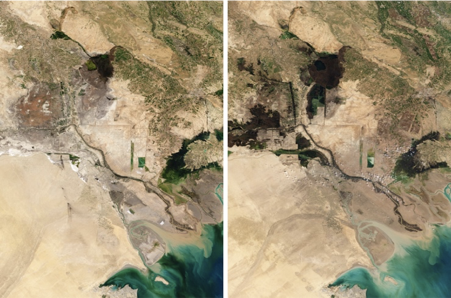
National Geographic images showing the progress of reflooding the marshlands between 2002 and 2007.
National Geography.
Iran’s Lakes Shrinking Fast Amid Severe Water Crisis
Wetland areas in Iran are similarly witnessing a massive reduction in size in recent years. This includes the portions of the Mesopotamian Marshes that exist in Iran and other areas of wetland that are of great importance to the greater ecological system in Iran. This damage and subsequent reduction in size is both the result of infrastructure projects that restrict the flow of water and damage due to the changing climate.
One example is the slow death of Lake Urmia, which is designated a wetland of international significance under the Ramsar Convention. The lake was once the largest salt lake in the Middle East but has seen a rapid collapse over recent decades with Iranian news agencies now declaring the lake as deceased.
The lake now measures roughly 581 Km2 which is a significant decrease from its original size of up to 6000 Km2 resulting in the lake almost entirely transforming into exposed salt flats through the loss of roughly 98% of its water volume since the 1980’s. The death of Lake Urmia poses an environmental and social crisis for Iran and threatens the health of nearby residents and the collapse of biodiversity.
The rapid decay of Lake Urmia was caused by a combination of causes including damaging construction projects and unregulated water extraction. Over 50 dams have been constructed on the rivers that feed into Lake Urmia which has significantly reduced the water flow to the lake by diverting much of the water away for agricultural use or to supply urban centres.
In addition to this, over 80,000 wells, many of which are illegal, are in operation around the lake, depleting essential water aquifers and contributing to the overall decline in the lake’s health due to the unsustainable nature of the unregulated wells.
Why Wetlands Are Disappearing Across The Middle East?
Aside from the specific examples discussed, wetlands across the Middle East have shrunk and decayed in recent decades. Many of these wetlands have suffered due to reasons specific to each case however, there are general trends and impacts that can be attributed to the overall disappearance of wetlands in the region.
Drought and Heat Accelerate Climate-Driven Collapse
The region has experienced a general increase in temperature that contribute to the damage to these wetlands and leads to more frequent extreme weather events such as drought. The average temperature in the MENA region has risen by over 1o degree Celsius over the past 30 years and is expected to increase by a further 5o degrees Celsius by the end of the century, if emission levels remain consistent.
“The average temperature in the MENA region has risen by over 1o degree Celsius over the past 30 years and is expected to increase by a further 5o degrees Celsius by the end of the century”.
Already, this rise in temperature has led to severe consequences for wetlands across the region and will only be exacerbated as the temperature continues to increase. The hotter climate increases evaporation rates in wetland areas which depend on retaining water for longer periods of time to maintain the ecosystem and protect the regions from the effects of drought.
The swifter evaporation process removes moisture from the wetland surface and soil, starving much of the flora and fauna that depend on the consistent water level. Additionally, it removes water that the wetlands would have purified and contributed to underground water reserves and as a result, decreases valuable freshwater resources for human populations.
As droughts now have a much larger impact on wetlands than before, these areas dry out much faster and shrink at an increasing rate. Wetlands act as a natural cooling device that, by their retention of water and presence of plant life, decrease the temperature of the surrounding climate and protect it from extreme heat and drought.
However, as droughts become more common, the ability of wetlands to cool the local climate diminishes. This further increases the frequency and severity of future droughts and contributes to a swifter destruction of wetland ecosystems.
This process transforms wetlands from natural carbon sinks into damaging carbon emitters as much of the processes that cleanse the air of carbon and other greenhouse gases are broken down and retained carbon is released. This contributes to the brutal cycle of destruction that is causing the accelerated depletion of wetland areas and their benefits.
Water Mismanagement And Dam Construction
Many wetlands suffer from poor water management that see much of their water sources diverted or removed and starves the wetlands of the consistent waterflow they depend on. In addition to the degradation of waterflow to Lake Urmia in Iran, many wetlands are suffering due to a growing number of unregulated and unsustainable wells that extract water that should be feeding the wetlands.
Wetlands are subsequently lacking significant amounts of water that would be fed off and protect the area from drying out. As wetlands are receiving less water from local sources, the contribution of these wetlands to underground water reserves are also diminished which forces more aggressive welling and drilling to extract enough water to supply the growing demand.
The operation of these wells also contributes to the pollution of the water reaching wetlands and further damages the area as the pollutants poison plant life and alter the fragile ecosystem. Major infrastructure projects, in particular dams, upstream from wetlands are a significant contributing factor to the reduction in water supplied to the wetlands.
Dams and other structures massively alter the water flow and remove much of the natural sediment that is essential to the overall health of a river. According to an environmental report in 2023, over 60% of the earths rivers are fragmented by some form of manmade obstruction and this figure is only likely to rise as nations depend on these freshwater sources ever more intensely to supply water and electricity.
Such an amount of notable structures altering river flow damage wetlands globally by altering the flow of the most vital water source to wetlands and therefore, significant damage the local ecosystem.
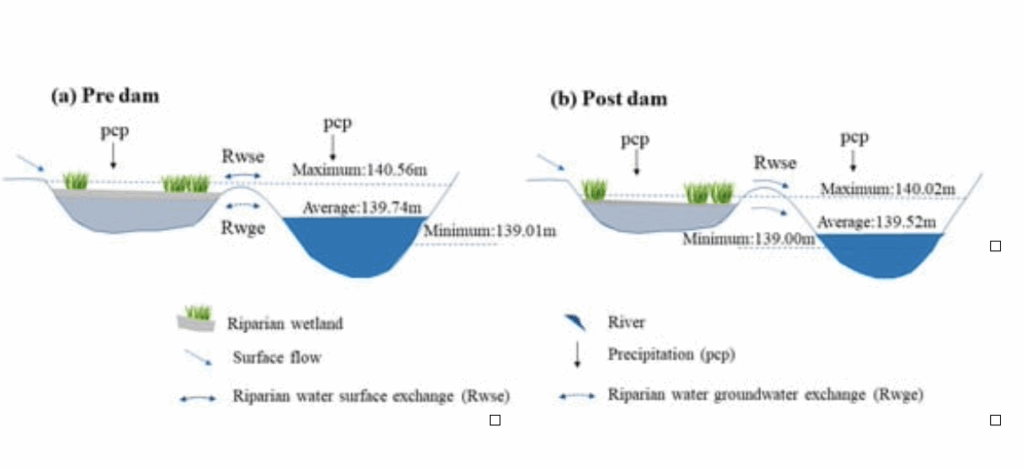
Diagram showing how dams effect the average water level in wetlands.
MDPI Dam Effects on Downstream Riparian Wetlands: The Nenjiang River, Northeast China, September 2019.
Pollution And Urban Expansion Are Damaging Fragile Habitats
As cities expand and populations surge, the pressure on water supply is increased and water management agencies are forced to pursue more aggressive extraction techniques to keep up with demand. The global urban population is expected to increase massively and, as a result, many more people will face water security by 2050; up to 1.1 billion more people.
People already consume far more water in urban settings and so as urban population grows, due to rural migration or urban reproduction, greater amounts of water will be redirected from wetlands to cities where they will provide for an important portion of urban water demand. In addition to this, urban growth physically threatens wetland habitat as urban areas expand close to or on top of these wetlands. This massively interrupts the natural ecosystem and introduces foreign agents to the fragile habitat such as invasive plant or animal species.
The physical development of cities significantly damages wetland ecosystems and have contributed to a massive loss of area in recent years with 1300 Km2 of wetland area being occupied by an artificial impervious area.
“The physical development of cities significantly damages wetland ecosystems and have contributed to a massive loss of area in recent years”.
Furthermore, the rapid expansion of urban areas, both bordering and far from wetlands, lead to a massive rise in pollutant emissions into the air and the waterflow. According to a UN Environment Programme report, over 80% of the worlds wastewater is released into the environment without treatment; with this figure increasing to over 95% in the least developed countries.
“According to a UN Environment Programme report, over 80% of the worlds wastewater is released into the environment without treatment; with this figure increasing to over 95% in the least developed countries”.
The untreated wastewater will flow through vital water sources and into the wetlands themselves leading to long-term pollution of the water and the habitat around it. Pollution contributes to the overall disappearance of wetlands in the MENA region and poses significant risks to wildlife and plant life and leads to public health crises as freshwater sources are poisoned by pollutants that are then supplied for human consumption.
The High Cost Of Losing Wetlands In The Middle East
The consequences of the disappearance of wetlands are already being felt across the Middle East and as there is currently not enough being done to halt the destruction of these vital areas, the effects will only increase in severity to humans and wildlife.
Biodiversity At Risk: Losing Species And Entire Ecosystems
Wetlands provide a habitat for countless unique species and host a complex ecosystem that is at risk of collapse when only a minor part is damaged or disrupted.
Following the draining of the Mesopotamian Marshes in Iraq, a mass disappearance of numerous endemic species was witnessed in the region. Species such as the Bunn’s short-tailed bandicoot rat, the smooth coated otter and the Persian Fallow deer could not survive in the conditions after the near destruction of the marshland and disappeared from the area.
The smooth coated otter is unique to the Iraqi marshlands and therefore, the destruction of their habitat leads to a destruction of their species. After the draining of the marshes the species were believed to have gone extinct in the region however, following reflooding attempts they have been witnessed among the reeds of the wetlands once again. Their numbers are small however, numbering only a few hundred, and any further damage could spell disaster for the extremely endangered species.
Furthermore, the Mesopotamian Marshes host thousands of birds species that migrate between Africa and Asia. Specifically, the marshes are an essential stopover point along the West Asian-East African flyway and the Siberian-Caspian-Nile route.
During the long migratory route, the marshes provide a vital resting ground, and the health of the wetland is essential to the success of the bird species in completing their seasonal migration. For example, during the winter migration, an estimated 50% of the entire marbled duck population rest and feed in the marshland area.
Another example includes the Basra Reed Warbler whose breeding ground is almost exclusively found in the Iraqi Marshland and a destruction of this breeding ground would lead to a significant drop in population size of the species, if not a complete extinction. The destruction of the Iraqi Marshland would destroy the wildlife that inhabits the area and would impact global bird populations as a vital migratory stopover would disappear.
The Human Cost: Communities Losing Water, Livelihoods And Heritage
The most immediate impact of the disappearance of local wetland areas would be a dramatic increase in water scarcity. Wetlands are a vital freshwater source globally storing approximately 1 million gallons of freshwater for every acre, according to the United States Environmental Protection Agency.
In a region such as the Middle East, that already struggles with severe water shortages and overall water insecurity, a disappearance of wetlands would massively diminish the region’s water storage and water output. Areas that depend on wetlands to supply underground water sources would lose another source of freshwater.
The severity of this would be especially felt times of drought which is typically eased by wetlands ability to slowly release retained water over long periods of time, however, if lost, a vital tool in mitigating the devastating effects of drought would disappear.
The Mesopotamian Marshes provide a unique example of a culture that depends on and lives harmoniously with the wetlands and as a result, the future of their civilisation is intertwined with the fate of the wetlands. The Marsh Arabs or the Ma’dān are believed to have inhabited the Iraqi marshlands for up to 5000 years and their livelihoods depend entirely on the existence of the marshlands. Traditionally they would live in housing built from reeds harvested from the marsh area and are constructed upon artificial islands made of mud and reeds.
They depend on consistent water flow and healthy rivers as a means of transportation as they travel using canoes called mashoofs or taradas. The forced draining of the marshes by Hussein displaced up to 500,000 local inhabitants from their habitat in the marshlands.
This highlights how any disruption to the wetland ecosystem also incurs significant damage to the culture and lives of the people who inhabit the area. Few Marsh Arabs are able to preserve traditional livelihoods among the waterways of the Iraqi wetlands and despite UNESCO enshrining the area, and its unique culture, as a heritage site in 2016, there is fear the traditional culture will never truly recover.
Can The Middle East Save Its Wetlands? Pathways Forward
The Iraqi Marshland Restoration Project was historic as it was the first commitment of its kind to bring together numerous NGOs that are all desperate to save and revive one of the world’s most important wetland systems. It has shown some success; however, the wetlands have not fully recovered and more must be done to ensure their survival.
A key step in assisting the overall rejuvenation of the Middle East’s wetlands is first ensuring the growth and health of mangrove systems. These important wetland ecosystems exist along coastal areas and provide a key buffer between inland water resources and the sea.
Mangroves can prevent saltwater intrusion and maintain a healthy level of salinity in the soil and water that other inland wetlands feed off. Saltwater intrusion is a major threat facing the region’s wetlands and focus must be put into ensuring a healthy and clean water supply for these wetlands to protect their overall utility.
Another essential step is to integrate water management technology and ensure it lives harmoniously with nearby wetlands. This would require cross border water sharing and distribution agreements which have been extremely hard to coordinate between countries in the region.
However, the damaging effects of the destruction of wetlands will not discriminate based on nation and it is beneficial for all parties to agree on a shared policy in order to protect the wetlands. This involves the construction of new water treatment plants and the renovation of larger precision irrigation systems to ensure vital water resources are not wasted and to share freshwater between urban demand and wetland supply.
Additionally, it is important to monitor the changes that certain infrastructure projects have on wetlands and ensure that upriver dams do not inhabit the flow of water to wetlands, although this is extremely hard to execute on an international scale as wetlands typically feed off numerous rivers that flow through multiple countries.
Wetlands are a vital key in climate stability and freshwater supply; however, their disappearance is largely ignored by many. The continued overextraction of water from these areas has stripped much of the ecosystem away and it will be hard for many in the region to truly, fully heal.
However, there is still hope and significant efforts to restore the Mesopotamian Marshes in Iraq have shown that progress can be made but that progress must begin in order soon to avoid an environmental and human disaster.
Copyright © 2026 Blue Tunisia. All rights reserved.