Iranian President Masoud Pezeshkian issued a dire warning in early November, stating that unless rainfall provides immediate relief from the current drought, Tehran, Iran’s capital and largest city, may have to be evacuated. This unprecedented proposal underscores the severity of the threat currently facing the residents of Tehran. The worsening water crisis follows months of little rain, crucial for replenishing Tehran’s water reservoirs after the hot summer. This lack of rain will lead to significant impacts to all aspects of life for Iranian citizens, and with no rain expected in the coming days, the water crisis is likely to continue deteriorating.
Factors behind the country’s severe drought
The causes of the current crisis are a result of both long-term and short-term issues, as well as environmental factors combined with continued abuse of the nation’s ecosystem. For decades, fears over Iran’s water scarcity have persisted, consistently ranking it as one of the most water-stressed nations on earth, however these issues and warnings of imminent water shortages have been routinely ignored, contributing to the severity of the current crisis.
How is Declining Rainfall Fuelling Water Shortages?
The immediate catalyst for the crisis is a notable lack of rainfall in recent months. While mild drought and close to no rainfall are common during Iranian summers, water stored in dam reservoirs around Iran’s major cities typically provide freshwater during this period.
However, this supply can only last so long, and autumn and winter rains are essential to replenish depleted resources. This year, however, no autumn showers returned, leaving Iranian cities to further consume the limited water reserves. This trend is not limited to this year alone, as the International Federation of Red Cross and Red Crescent societies have reported that over recent years, the annual precipitation has been 75% lower than the long-term average. A long-term reduction in rainfall has contributed to the severity of this seasons drought and is not only a result of the disappearance of the autumn showers this year.
n July of this year, The New York Times reported that Iran was on the brink of a crisis due to the depletion of the capital’s water reserves. Months have passed since this warning, and weeks of no rain have only worsened the situation with no relief expected in the coming days. According to a BBC report, the Latian dam, one of Tehran’s most essential water reservoirs, is now at less than 10% of its normal capacity, a figure that may be as low as 5%.
It is important to note that the water crisis is not limited to Tehran and numerous reservoirs across the country are grappling with dwindling supplies. According to the Guardian, the city of Mashhad is also witnessing an increase in water shortages, with dam reservoir supplies falling below 3%. This crisis is wide-ranging and will only be exacerbated as the drought intensifies.
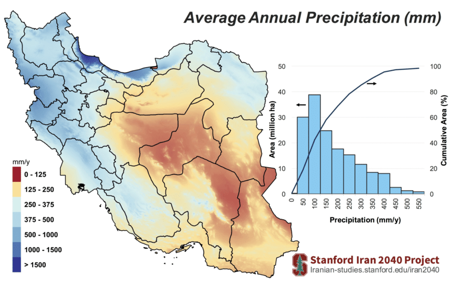
Image showing the massive reduction in annual rainfall over Iran.
Mesgaran, Mohsen & Madani, Kaveh & Hashemi, Hossein & Azadi, Pooya. (2016).
Evaluation of Land and Precipitation for Agriculture in Iran.
Warming Climate Intensifies Iran’s Deepening Drought
The current drought is also a further consequence of the changing climate which increases Iran’s susceptibility to extreme weather such as drought, flooding and heat waves. Over the past decades Iran has witnessed a rise in temperature by around 2 degrees Celsius with a report from The Atlantic Council expecting the temperature to increase by a further 2.6 degrees Celsius by 2050 and result in more days numbering over 50 degrees Celsius.
This rise in temperature has been followed by a decrease in rainfall which leads to a swifter and harsher desertification process in the country. As desertification continues key water resources decrease and disappear with key lakes, including the Urmia lake, and rivers being massively depleted. These changes in the environment are exacerbated by poor management.
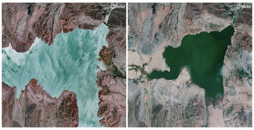
Images showing the massive reduction in water reserves from September 2024 to September 2025 in the Sefidrud Dam.
Reuters pictures.
Water Mismanagement: A Central Factor Behind Iran’s Drought
Iran’s current water crisis is not a surprise for many, as for years the situation has been deemed untenable. The issue was even highlighted by the Iranian Supreme Leader almost a decade and a half ago, in 2011, when he warned of coming water shortages. Despite these warnings, little has been done to address the concerns, and many experts believe the crisis was inevitable. This view is shared by the majority of the Iranian population as around 75% of Iranians themselves blame the government for its poor water management.
State policies concerning water conservation have been criticised for years with long-standing unsustainable practices being of major concern such as illegal well drilling and irresponsible agricultural water management. The presence of illegal wells is particularly concerning as many local NGOs, such as the Water Saviour Population and Water protectors, estimate that there are approximately 500,000 of such wells operating in the country. These unlicensed wells typically face no regulation on their extraction and as a result contribute to swifter depletion of water resources, especially in times of drought.
Over the last decades, Iran has almost entirely depleted its groundwater reserves through overextraction by illegal wells and poor water management by state ran systems. This depletion has resulted in severe land subsidence in some of the most water stressed areas of the country, in particular Tehran.
Population Growth Intensifies Pressure on Iran’s Water Resources
The depletion of groundwater reserves is further compounded by a massive increase in the capital’s population which has the population grow from around 1 million in 1950 to close to 10 million today. Water reserves around the city have simply not been able to account for this growth and frequently fails to reliably provide freshwater for Tehran.
This growth was seen across the nation as the population boomed in the second half of the last century, however, urbanisation in turn accelerated putting increased pressure on the supplies to cities. The Statistical Centre of Iran estimates that at least 75% of the population live in urban areas now in comparison to 30% in the 1960s.
As traditional methods of water storage and extraction failed to provide enough water for each cities growing population, the state turned to less sustainable practices which have only become increasingly damaging as they struggle to provide for the growing city. This results in an even more water-stressed supply as the nation struggles to provide fresh water for all its citizens, and those who live in urban centres are hit particularly hard.
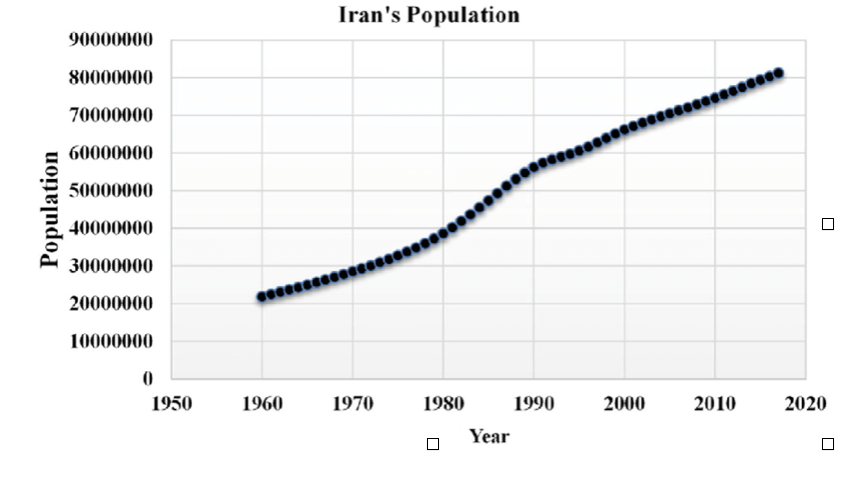
Hosseini, Seyed & Saifoddin, Amirali & Shirmohammadi, Reza & Aslani, Alireza. (2019).
Forecasting of CO2 emissions in Iran based on time series and regression analysis. Energy Reports.
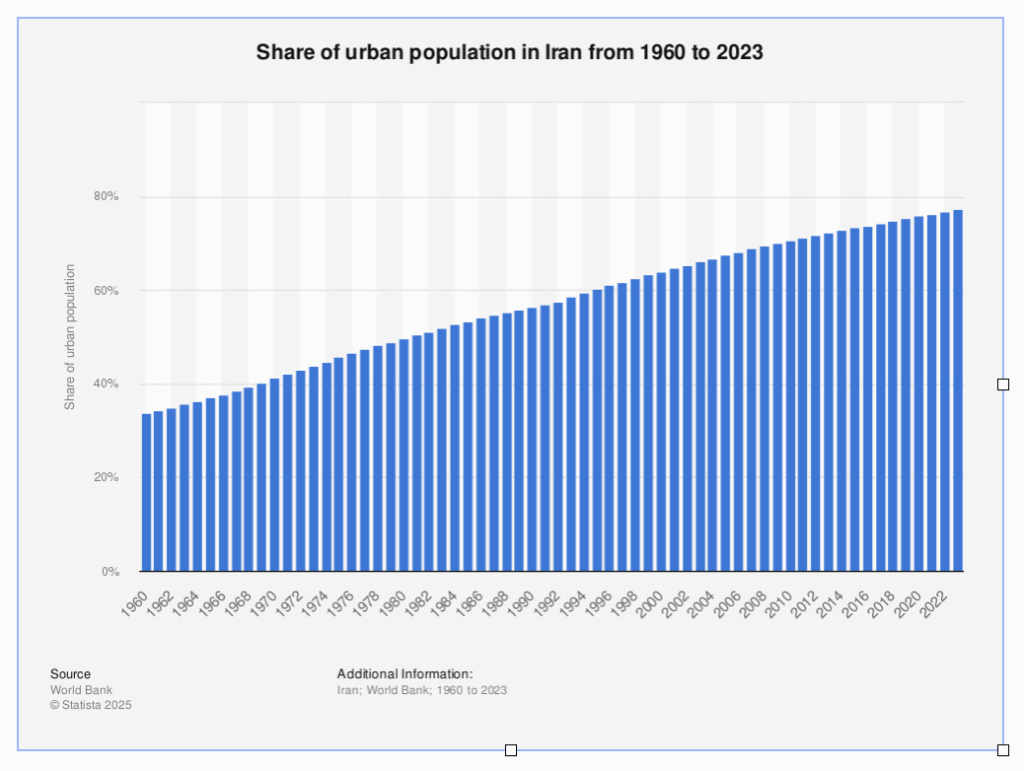
Graph depicting urbanisation rate in Iran.
The Word Bank.
Poor Agricultural practices deepen the country’s drought vulnerability
Furthermore, agricultural practices in Iran have long been criticised for failing to conserve water effectively. The efficiency of irrigation systems in Iran is extremely low meaning considerable amounts of water is used on non-arable land or much of the allocated water is lost during transportation to the farm, as a result of outdated or poorly managed systems.
A report from the National Academics calculates that the efficiency of irrigation systems operated by the private sector , which heavily relies on groundwater reserves ,is around 35%, however, this figure is even lower on government operated irrigation systems as its efficiency rate may be as low as 20%.
Furthermore, agricultural systems need to adapt to the depletion of groundwater reserves and as a result depend heavily on these outdated irrigation practices. The Iran Water and Resources Management Company reports that approximately 55% of the irrigated land in the country depends on groundwater which firstly led to greater rates of extraction of groundwater reserves to assist farmland during drought.
But, as groundwater reserves have been massively depleted, farms have had to turn evermore to these ineffective irrigation systems which contributes to an even greater loss of water. Furthermore, it is important to note the massive allocation of the nation’s freshwater for agriculture purposes with roughly 92% being used for agricultural purposes. Much of this water is then wasted through poor irrigation systems, meaning vast amounts of freshwater in Iran is neither providing for the citizens or the nation’s farms.
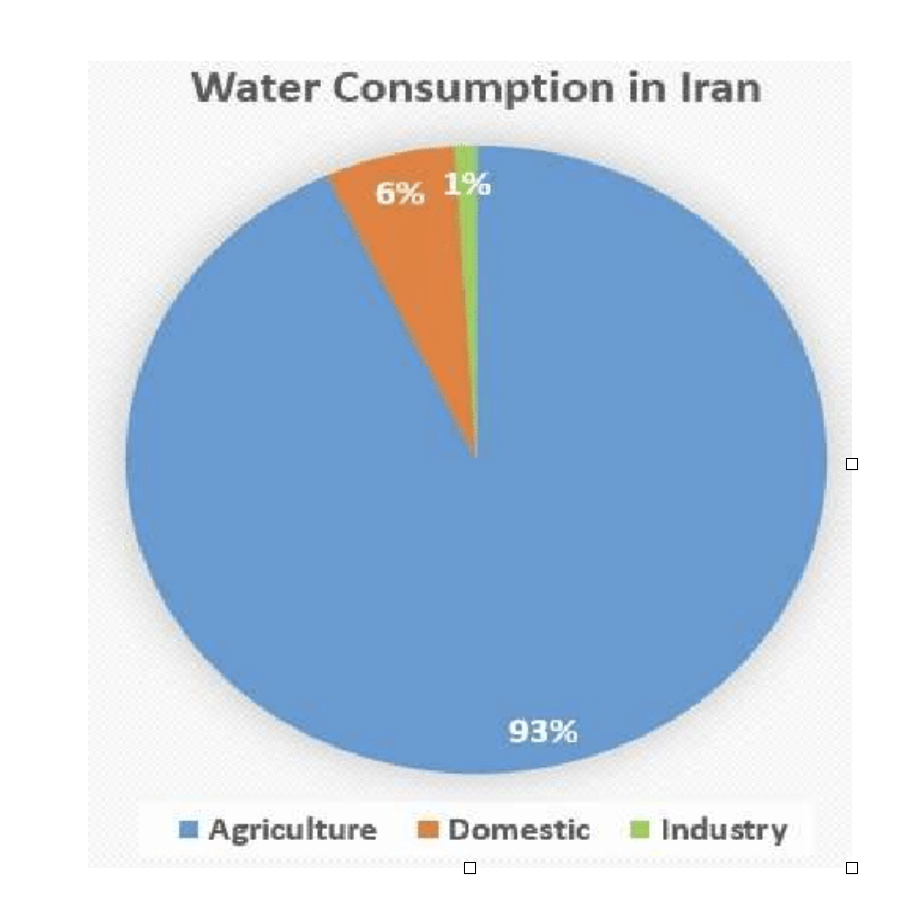
Graph showing freshwater allocation in Iran.
Aryanfar, Yashar. (2020). A Review on the Water Sector in Iran: Current Forecasts, Scenario and Sustainability Issues.
Drought fallout: What Iran is losing as its water runs out
The immediate consequences of the crisis are still unclear as Iranian officials weigh up the potential solutions while hoping that overdue rain relieves the situation before any drastic measures have to be taken. The most significant option is the evacuation of the capital, Tehran, which has been discussed as a possibility unless the shortage improves dramatically.
However, executing such a task would undoubtedly lead to massive upheaval for those affected and how an evacuation of that scale would be undertaken is unknown. In the immediate term, the current water crisis poses serious threats to the livelihood of Tehran and Iranian residents.
How Will the Water Crisis be Felt Across Iranian Society?
Officials have warned that water rationing is likely in the coming days, although some reports suggest it has already begun. This threatens approximately 16 million people with dry tape and the inevitable shortage of drinking water available in shops as Iranians stockpile bottled water to see them through the deepening crisis. The threat of tap water being shut off poses significant risks to citizens in a nation fréquente experiencing high temperatures and could lead to health issues such as dehydration. Those considered at medically high risk as well as the elderly may be more affected in these circumstances, especially if the water rationing affects hospitals and other essential medical services.
The impact of this crisis will also lead to varying consequences, with stark disparity in its effects. Wealthy Iranians will likely be able to afford to stockpile drinking water and prepare more effectively for any shutdown of the city’s tap water or potential evacuation, while other residents of Tehran will lack the money or ability to purchase large quantities of water to see them through the coming disaster.
For small businesses that have higher water consumption such as those operating in the hospitality sector or the construction industry, a reduction in the availability of freshwater could be catastrophic and possibly lead to layoffs and further deepen the long-term economic effects.
Agricultural Risk: Iran’s water crisis hits farms hard
The enduring impacts from this drought will additionally be felt in Iran’s agricultural industry, threatening further consequences in the future. Following a dry summer, the nation’s farms rely on consistent rainfall throughout the autumn and winter months; a relief which hasn’t been present this year with a 92% decrease in rainfall compared to last year according to the director of the Karaj dam. This prolonged reduction has already massively changed Iran’s agricultural industry with over 90% of Iran’s freshwater reserves needing to be committed to the agricultural industry.
“92% decrease in rainfall..”
Worries that severe water shortages will become more common will lead to more agricultural workers abandoning their residences and villages to pursue lives in cities, further exacerbating a dwindling water supply that cannot, as of now, reliably provide for most people.
As agricultural output declines due to increased volatility in the sector then food prices will rise as products become harder to grow domestically possibly forcing Iran to depend heavily on foreign agricultural imports. An increase in price for the most basic products will damage the livelihoods of many Iranians who are forced to survive on minimal pay from an economy rattled by foreign sanctions.
Arable land in Iran is already limited and therefore farms are forced to work with extremely hostile conditions in order to produce enough food however, as the water crisis continues the vast majority of land made arable through agricultural vegetation may see a reduction further contributing to a decrease in food supply and in increase in human migration away from the agricultural industry.
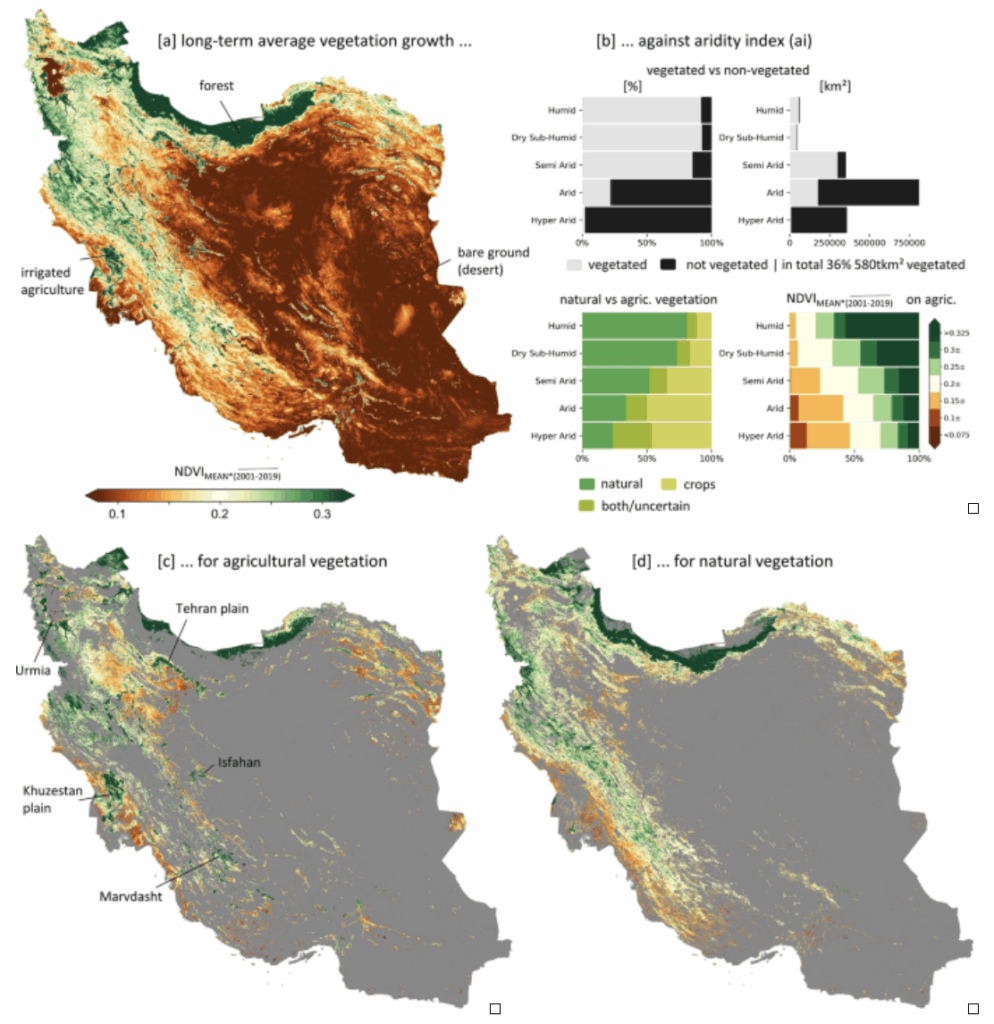
Behling, R., Roessner, S., Foerster, S. et al. Interrelations of vegetation growth and water scarcity in Iran revealed by satellite time series. Sci Rep 12, 20784 (2022)
Geopolitical Tensions Rise Amid Iran’s Water Crisis
The government will feel anxious that these effects will increase dictatorial among the Iranian population in the face of a struggling economy. The nation has previously seen mass protests as a result of water shortages and the current drought, along with its economic impacts, threaten civil strife once again. The minister of energy, Alias Aliabadi, claims that its brief war with Israel in June damaged essential infrastructure leading to the current water crisis however, there is little evidence to suggest that the water shortage would have been avoided had the conflict not taken place. Blame for the current crisis is most frequently laid on the government and dissatisfaction will rise as a result.
The Environmental consequences of Iran’s water crisis
The long-term ecological effects will continue to harm the struggling Iranien ecosystem and accelerate the process of desertification which poses serious risks to the country’s fragile environment. Already the nation has seen a mass die off of aquatic live and flora that depends on Lake Urmia which is now a large salt flat and the reduction in the Zayandeh river which frequently runs dry. As water reservoirs shrink and resources deplete the state may accelerate its current extraction practices to ensure steady flow of freshwater to population centres.
As this process continues desertification will become more severe and further harm arable land with over 100 million hectares of land at risk of becoming deserts in the near future. As land degradation deteriorates the environment’s natural ability of carbon retention is severely harmed, the effects of which are already being felt as drought severity has massively increased over recent years. This dangerous cycle contributes to a more hostile environment which in turn reduces Iran’s ability to survive on the land. The current drought is itself, in part, a result of climate change and will contribute to the increasing frequency and severity of similar droughts in the coming years.
“over 100 million hectares of land at risk of becoming deserts in the near future.
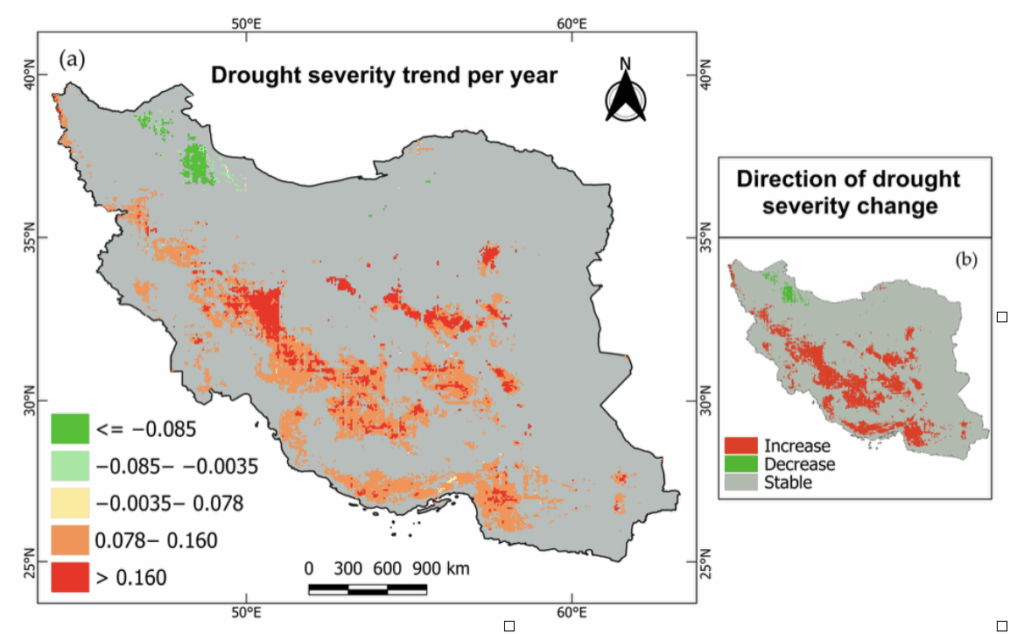
Torkaman Pary, Atefeh, Pejvak Rastgoo, Christian Opp, Dirk Zeuss, and Temesgen Alemayehu Abera. 2024.
“Impacts of Drought Severity and Frequency on Natural Vegetation Across Iran” Water 16, no. 22: 3334.
Solutions on the Horizon: Tackling Iran’s Water Scarcity
Efforts to ease Iran’s water crisis have focused mainly on residents. People are encouraged to reduce daily water use. Legal actions threaten those who use too much. While this may slightly reduce pressure on tap water, it won’t solve the problem. Experts say long-term systemic changes are needed. Iran must improve water storage and modernize groundwater extraction and irrigation systems. These changes will be costly and won’t help with immediate drought effects. Therefore, Iran also needs urgent solutions to cope with worsening droughts.
Could Cloud Seeding Help Mitigate Iran’s Drought?
Iran has been pursuing cloud seeding for some time in the hope that it could sole current and future water crises by avoiding the mass disappearance of rainfall, as seen this year. Cloud seeing involves the release of particles, in particular silver iodide, into the atmosphere to increase the weight of water molecules in the cloud and encouraging rainfall. The US government estimates that the process can increase rainfall by up to 20% but results massively vary depending on the circumstances in which the process takes place.
There is considerable hope in Iran that cloud seeding could ease drought in the country through increasing rainfall with some studies suggesting that the process could increase precipitation by up to 40%; a much higher figure than other tests.
Moreover, the Iranian Ministry of Energy have announced they are utilising cloud seeding methods currently to ease the drought and plan to continue the process through to next year. However, the consistent effectiveness of the process is in doubt, and many don’t believe on its own it can solve Iran’s water crisis.
The process depends on the presence of the appropriate cloud variety for cloud seeding to increase precipitation, but Iran has not only suffered from a lack of rain but also of suitable moisture-laden clouds. Without the natural presence of such clouds, it is unlikely that cloud seeding will be effective at increasing rainfall and certainly won’t be enough to solve the current crisis, according to Iran’s Meteorological Organisation.
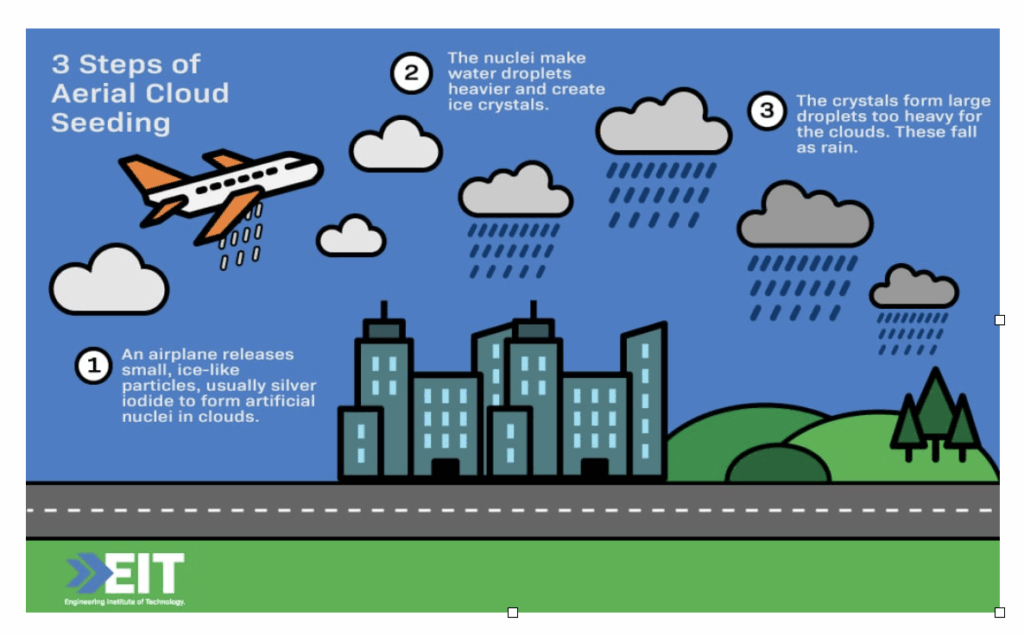
Can Innovation Help Iran Reverse its Deepening Water Crisis.
One of the main methods of assisting Iran’s water crisis is by increasing the efficacy of its irrigation system through reducing water waste. As described above, Iran’s current irrigation systems are ineffective at conserving water and result in much of it being lost through outdated or poorly designed systems. One système currently being advised is the adoption of drip irrigation which is estimated to achieve close to 95% efficiency, a much higher figure than is being achieved by any private or state-run irrigation system.
The method involves micro-irrigation that deposits moisture and nutrients right at the root of the plant. The system would massively reduce waste once utilised on farmland however, it would not address the amount of water lost on route to the nation’s farms, most notably through inadequate piping. The Iranian government is openly supporting a mass adoption of drip irrigation systems through investment and subsidies and aims to install drip irrigation systems over 70,000 hectares by the spring of 2026.
However, as of now, there has been a considerable lack of adoption of new irrigation systems across the country with only 3.1 million hectares of land using updated irrigation systems compared to a total area of around 20 million hectares of farmland in Iran. This means the vast majority of the nation’s farms still use the traditional and ineffective irrigation systems and contribute to the
large amounts of water wasted during the agricultural process.
While innovation to Iran’s irrigation systems will conserve a massive amount of freshwater and therefore diminish any future drought, it cannot, as of now, help mitigate the effects of the current water crisis.
Is Desalination the Strategic Answer to Iran’s Water Crisis?
Desalination removes salt and minerals from seawater to make it drinkable. Iran has several desalination plants along its southern coast by the Persian Gulf. These plants supply water to Hormozgan and Bushehr provinces, producing 638,000 cubic meters daily, about 3% of Iran’s drinking water. This eases demand on central reservoirs. Plans exist to build pipelines from the coast to northern and central regions. However, desalination is costly and energy-intensive. Iran’s plants run on fossil fuels, raising concerns about sustainability. Expanding desalination could increase greenhouse gas emissions, worsening climate change and threatening Iran’s future water security.
Furthermore, the process of expanding the reach of freshwater acquired through desalination is an extremely expensive and arduous process which would involve the construction of numerous pipelines, in particular the so-called ‘Line of Hope covering 800-1000 miles and estimated to take years to build.
Once completed, it would provide neither an environmentally sustainable or a cheap alternative to current water extraction practices with the cost estimated at 15-20 times higher per cubic metre than water providing through the current methods. In the short-term however, desalination has been proven to provide a high rate of freshwater compared to other methods and therefore, could certainly bolster Iran’s water supply.
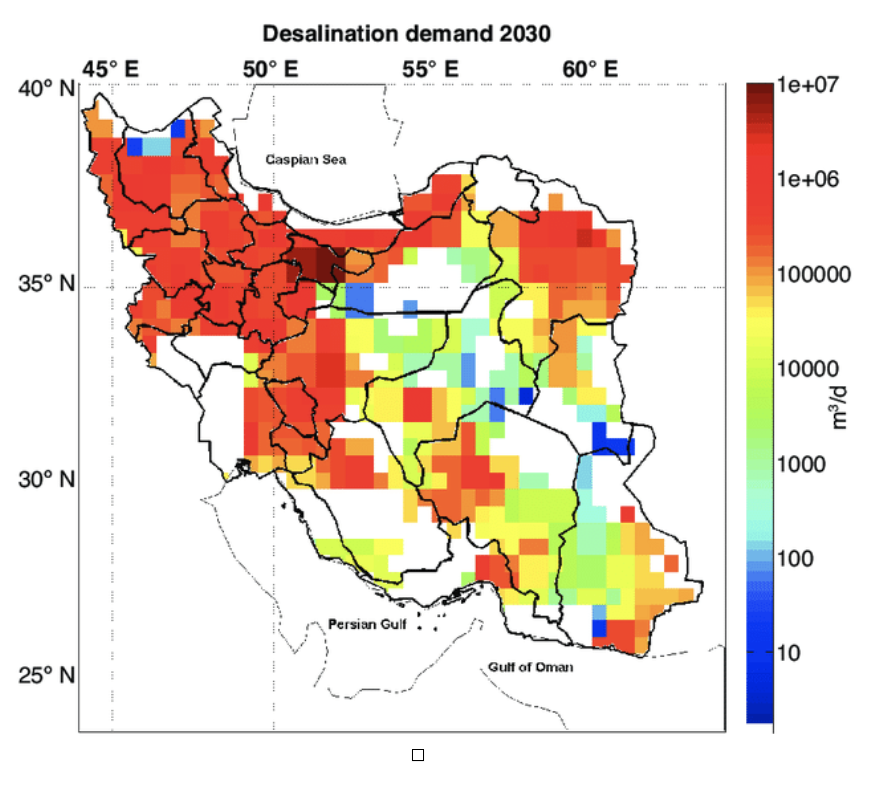
Caldera, Upeksha & Bogdanov, Dmitrii & Fasihi, Mahdi & Aghahosseini, Arman. (2019).
Securing future water supply for Iran through 100% renewable energy powered desalination.
International Journal of Sustainable Energy Planning and Management. 23.
Wastewater Reuse Emerges as a Critical Solution to Water Scarcity
The Iranian government has officially recognised wastewater reuse as a critical strategy for easing the water scarcity crisis, and its effectiveness could prove essential for future solutions to the droughts facing the country. Wastewater reuse involves a process of treating water over several stages to make it hygienic and drinkable for humans and healthy for agricultural irrigation. Wastewater reuse plants collect the water flowing from homes, businesses and industries and conditions it through numerous processes that involve physical separation of harmful material from the water, followed by advanced biological cleaning stages that prepare the water to be reused as drinking water or to be utilised again through industry or agriculture.
Municipal wastewater is estimated around 4.61 billion cubic metres annually of which only 42% is treated. Increasing the rate of this treatment could significantly enhance Iran’s water supply and provide a sustainable and clean method of replenishing freshwater supplies in the long-term.
“Municipal wastewater is estimated around 4.61 billion cubic metres annually of which only 42% is treated. Increasing the rate of this treatment could significantly enhance Iran’s water supply and provide a sustainable and clean method of replenishing freshwater supplies in the long-term.”
The process if largely regenerative as little water is wasted during the process, meaning if the majority of wastewater is treated effectively, then the pressure on the shrinking water reservoirs would be eased. The government has invested heavily in this process and believes it is an important step to effective state-reliance on water resources. The government aims to provide agriculture with the vast majority of its water through treated wastewater, with approximately 82% of treated wastewater already going to farmland.
The process could prove massively beneficial, especially if it can end up becoming the main supplier of freshwater to the nation’s farmlands, as that would allow the freshwater reservoirs to provide solely drinking water to Iranian citizens, rather than providing for numerous industries as it is currently attempting to do. One of the main issues facing the implementation of a massive growth of wastewater reuse plants is the uncoordinated development of the method, which results in loose cleansing regulations and issues facing the streamlined processing of the water from one treatment process to the next.
Conclusion
The current water crisis in Iran poses significant risks to Iranian citizens and while solutions to the crisis are intensely discussed, none are likely to provide immediate relief from the drought. The immediate future remains unclear for the Tehran residents who live with the threat of evacuation and dry taps looming over them however, it is vital that changes are made to avoid a similar crisis in the future. The solutions discussed are just a few that could aid the country’s water shortage and possibly prevent drought all together, however, every consideration is weighed down by countless risks and will incur a significant price to undertake which will hinder any progress in the short-term.
Copyright © 2025 Blue Tunisia. All rights reserved.