An expanding an advanced space programme is a key pillar in their Vision 2030 plan , aimed to diversify the economy beyond oil and advance Saudi Arabia’s position as a global in leader in science and technology development.
Saudi Arabia have recently made importance strides in advancing their space industry such as sending astronauts to the International Space Station in 2013, including the first female Saudi Arabian astronaut, Rayyanah Barnawi.
In addition , Saudi Arabia wishes to play an important role in future space technology advancement on the global scale by signing key agreements with the USA to conduct missions with NASA. Saudi Arabia is currently in the early stages of the development of its space programme however, the country hopes that it will become not only a regional, but a global leader in the advancement of future space travel and technology.
From Oil Economy to Orbital Vision: Why Saudi Arabia Wants Space?
The Vision 2030 Plan, launched by Saudi Arabia in 2014 to overhaul the economy and move away from a dependence on fossil fuels. The country aims to do this by investing heavily in numerous sectors such as scientific advancement including space technology.
The Saudi Space Agency works to operate missions involving satellites, data services and manned missions, all of which are hoped to boost the Saudi economy and expand its scientific sector. A major component of this scheme is to expand the job opportunities in skilled fields and allow professionals to work in a strong sector that does not involve fossil fuels or oil.
the heavy investment into space technology fosters economic growth in a sustainable sector and promotes young graduates to pursue scientific careers in an evolving industry that is hoped to bring in considerable investment.
Another major aim of the Saudi space investment is to ensure sovereign technological advancement and distance itself from the technology designed by other nations. This is a key step for multiple reasons.
Firstly, it strengthens the nation’s scientific industry by producing products and patents that can be sold elsewhere rather than buying such technology from other countries. Secondly, Saudi Arabia are most keen on technological independence, distancing itself from the communications services and satellite coverage used by other countries.
This would allow Saudi to be in complete control of its data and scientific research. By doing so it advances its strategic autonomy. Especially as Saudi Arabia aims to be the most advanced nation in the region for space technology, the country would possess significant strategic advantages over neighbouring countries by having sole possession over space technology and its data output.
Charting the Stars: Saudi Space Agency’s Ambitious Roadmap
All future progress in the country’s space ambitions run through the Saudi Space Agency which was created in 2018.
Strategic Spending: Budget Moves That Matter
While specific annual budgets are not publicly released, the investment is significant. The Saudi space economy was valued at $8.7 billion in 2024 and is projected to reach $31.6 billion by 2035, indicating a massive annual growth rate.
This growth is backed by investments in infrastructure and the launch of the Neo Space Group (NSG) by the Public Investment Fund (PIF) to boost domestic satellite and space industries.
“The Saudi space economy was valued at $8.7 billion in 2024 and is projected to reach $31.6 billion by 2035”.
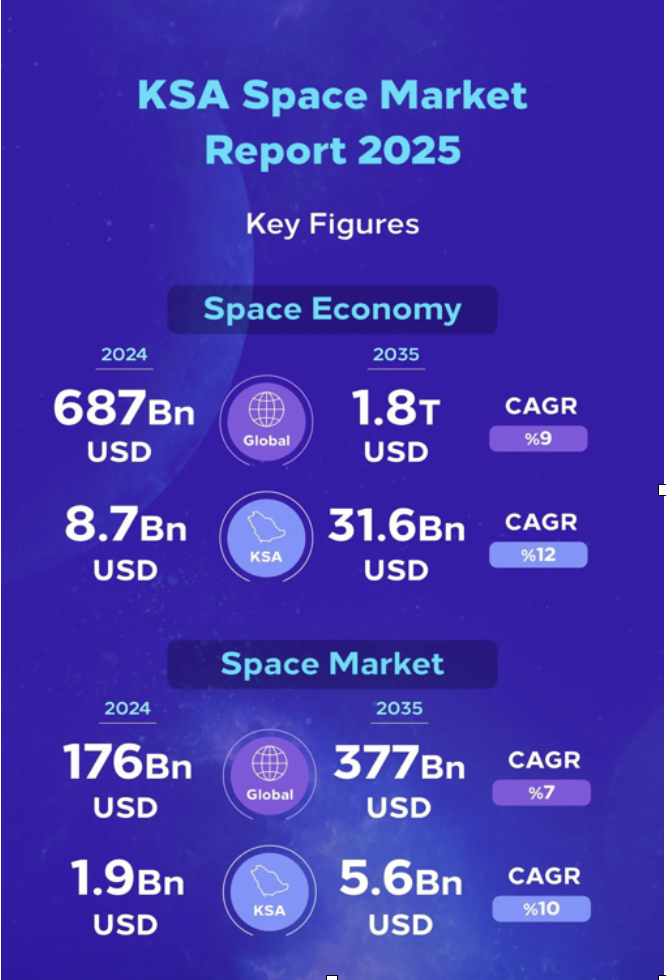
Key figures regarding Saudi’s space industry.
Saudi Press Agency.
Leading the Way: Saudi Arabia’s Flagship Space Programs
A cornerstone initiative is the sustainable Human Space Flight (HSF) Program, aimed at preparing Saudi citizens for professional astronaut careers on various missions.
- Historic ISS Mission (Ax-2): The inaugural HSF mission launched on May 21, 2023. Astronauts Rayyanah Barnawi, the first Saudi female astronaut, and Ali Alqarni travelled to the International Space Station (ISS) on a private Axiom Mission 2 flight. The 10-day long mission involved numerous scientific microgravity experiments focusing on human health and cell science, some of which engaged 12,000 Saudi students in real-time outreach experiments.
- Satellite Development: The SSA is fostering local talent through initiatives like the SARI competition, which led to the recent launch of two student-built satellites from Umm Al-Qura and Prince Sultan Universities.
- Future Missions: Flagship future plans include a commitment to lunar exploration and the development of a national spaceport. In partnership with NASA, the SSA plans to fly the Kingdom’s first dedicated space weather observation satellite on the Artemis II test mission, expected around 2026, to monitor solar activity and its impact on communications systems.
Space Without Borders: Strategic International Collaborations
Collaboration is central to the SSA’s roadmap, with strategic partnerships securing access to expertise and infrastructure.
- NASA & Artemis Accords: Saudi Arabia is a signatory of the US-led Artemis Accords, which promote transparent and safe space exploration. A framework agreement with NASA provides a legal basis for cooperation in civil aeronautics and space activities.
- Axiom Space: The SSA signed multiple Memorandums of Understanding with US-based Axiom Space, the private mission provider for the Ax-2 mission. These agreements cover astronaut training, the exchange of knowledge, and exploring the creation of a local mission control centre.
- Other Collaborations: The Kingdom has also engaged in agreements with China, including a joint study on solar cells aboard the Tiangong Space Station, diversifying its international portfolio. The SSA also plans to establish a Centre for Space Futures with the World Economic Forum to facilitate public-private space collaboration.
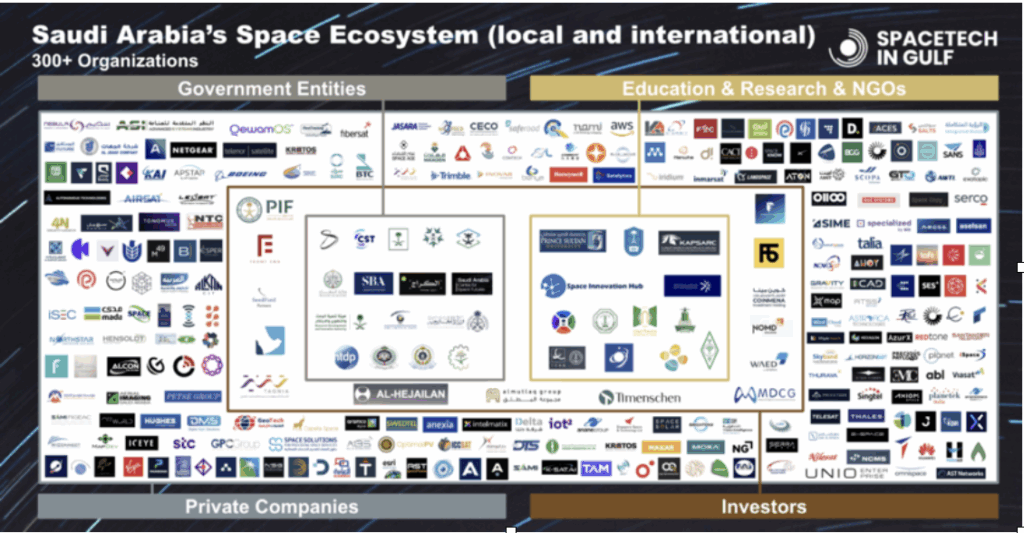
This Image shows the plethora of different organisations involved in the development of Saudi’s space ambitions.
SpaceTeck in Gulf
Earth Observation and Climate Monitoring: A Strategic Tool for the Gulf
For arid states in the Gulf region, Earth Observation (EO) and satellite technology are indispensable strategic tools in the fight against climate change. The region is highly vulnerable to environmental shifts, with over three-quarters of its land having become drier in recent decades. Space-based data offers a comprehensive, real-time, and high-resolution method to monitor these changes and inform crucial climate adaptation strategies.
- Tracking the Land: Fighting Desertification and Degradation
Satellites provide essential data for tracking the expansion of drylands and assessing land degradation. Remote sensing technologies identify hotspots of soil erosion, salinization (a common issue in arid regions where evaporation exceeds precipitation), and vegetation loss.
By analysing long-term data records of vegetation indices and albedo, policymakers can monitor aridity trends, enabling early detection of at-risk areas and guiding sustainable land management interventions, such as large-scale afforestation projects like those under the Saudi Green Initiative.
- Tackling the Thirst: Solutions for Water Scarcity
Water resource management is a critical challenge in the Gulf. Satellite data significantly enhances water management optimization by providing insights into rainfall patterns and groundwater levels, especially in areas with limited ground-based monitoring stations.
Data from missions like NASA’s Gravity Recovery and Climate Experiment (GRACE) help quantify groundwater storage changes, which is particularly useful for assessing drought risk and managing aquifers, a primary source of freshwater in the region.
- Solving the Coastal Erosion and Extreme Heat Issue
The Gulf’s extensive coastlines are vulnerable to erosion and sea-level changes. Satellite imagery allows for continuous monitoring of shoreline changes and coastal habitats like mangroves and seagrass beds, supporting the planning of resilient infrastructure and new economic developments.
Furthermore, EO helps track extreme heat events and the “urban heat island” effect in rapidly expanding cities by measuring land surface temperatures and other climate variables, aiding public health planning and urban design.
By integrating EO into national policies, the Gulf states can transform data into actionable solutions for a more resilient future. The UAE, for instance, has partnered with private companies to develop a “Loss and Damage Atlas” using satellite data to inform early warning systems and policy decisions.
This integration of space technology into environmental policy provides these arid states with the necessary tools to monitor, adapt, and build resilience in the face of escalating climate challenges.
Growing a Local Space Industry: Satellites, Startups, and R&D
Saudi Arabia is actively cultivating a local space industry to transition from being a consumer to a producer of space technology, a key component of its Vision 2030 economic diversification strategy. This initiative focuses on building domestic manufacturing capabilities, investing in leading research centers, and fostering an environment conducive to space startups.
- Building Satellites at Home: Saudi Arabia’s Domestic Innovation
The Kingdom is prioritizing the development of indigenous satellite manufacturing capabilities, with a focus on cutting-edge technologies like Synthetic Aperture Radar (SAR) and remote sensing satellites. This push is crucial for ensuring technological sovereignty and providing crucial data for environmental monitoring and national security.
The launch of the Neo Space Group by the Public Investment Fund aims to consolidate these efforts, ensuring a coordinated approach to building a self-sufficient industry in areas such as satellite communications, earth observation, and IoT applications. This localized production capability reduces reliance on foreign suppliers and stimulates related high-tech job markets within the Kingdom.
- Fueling Innovation: Strategic Investments in R&D
Significant investments are flowing into research centers and universities to drive innovation. Institutions like the King Abdullah University of Science and Technology (KAUST) and the King Abdulaziz City for Science and Technology (KACST) are at the forefront of space-related research, including satellite technology, materials science, and AI applications for data analytics.
KACST has a history of building and launching satellites, including the Saudi Sat 5, demonstrating foundational expertise that is now being scaled up to support a full-fledged industry. These collaborations between government, academia, and private sectors are vital for producing the R&D breakthroughs needed for a competitive space industry.
- Fueling Growth: Creating Thriving Startup Ecosystems
Fostering an entrepreneurial ecosystem is a key part of the strategy. The Saudi Space Agency (SSA) is collaborating with the World Economic Forum to establish a Centre for Space Futures, aimed at facilitating public-private partnerships and supporting new ventures.
Initiatives like SARI, a student satellite competition, engage and inspire the next generation of engineers and entrepreneurs, creating a talent pipeline for the emerging industry. By providing a supportive environment, funding opportunities, and access to research infrastructure, Saudi Arabia is encouraging startups to innovate and commercialize space technologies, from satellite design to downstream data services, ensuring a dynamic and self-sustaining local industry.
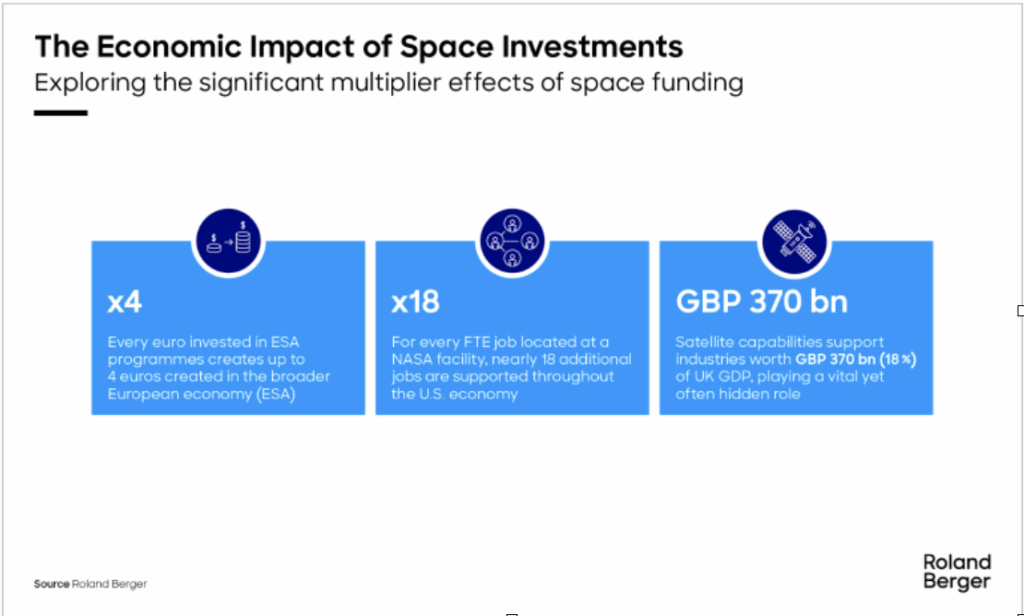
The impact of space programme investment on other economies.
Roland Berger
Regional Implications: What the Arabian Space Race Means for the Middle East
The rapid acceleration of space programs in the Gulf, led by Saudi Arabia and the UAE, is reshaping the Middle East’s economic and security landscape. The shift towards space-based initiatives reflects a broader strategic pivot away from traditional hydrocarbon economies and towards high-tech sectors, creating a dynamic mix of cooperation and competition across the region.
- Cooperate to Compete: Strategies Driving Growth
A key dynamic is the intense yet cooperative rivalry between the UAE and Saudi Arabia. The UAE set an early pace with its Mars Hope Probe and asteroid mission, while Saudi Arabia recently made headlines with its Human Space Flight Program. This competition acts as a powerful incentive for each nation to innovate and invest, with both countries building domestic space ecosystems and signing the U.S.-led Artemis Accords to ensure transparent and safe exploration.
The Arab Space Cooperation Group, which includes 10 Arab states, was established to foster region-wide collaboration and align strategies, though the pursuit of individual national champions like the UAE’s Space42 and Saudi’s Neo Space Group suggests a mix of shared vision and national self-interest.
- Changing Times: Evolving Economic and Security Priorities
Space ambitions are intrinsically tied to economic diversification under national visions like Vision 2030. Space technologies, such as Earth observation and secure communications, support a wide array of new industries, including logistics, agriculture, and urban planning for giga-projects like NEOM.
This shifts economic priorities towards knowledge-based economies and enhances national security autonomy by reducing reliance on foreign powers for critical intelligence and communication infrastructure.
The military applications of these programs are also a key consideration, raising the stakes in an already volatile region where geopolitical tensions and rivalries (such as with Iran) play out on new frontiers.
- Connecting North Africa: Strategic Partnership Prospects
For North African countries like Tunisia and Morocco, the Gulf’s space boom presents significant partnership opportunities. The broader Arab region has a total space budget exceeding $1.5 billion, and there’s a strong incentive for cross-country cooperation to meet regional challenges and improve socio-economic growth.
“The broader Arab region has a total space budget exceeding $1.5 billion”.
Multilateral dialogues, such as the 5+5 Dialogue which includes Morocco and Tunisia, can serve as platforms to strengthen regional interdependence in research, innovation, and higher education related to space. Collaborations can focus on areas like data sharing for climate monitoring or joint satellite projects, leveraging the growing expertise and investment capabilities of the Gulf states to benefit the entire MENA region.
Saudi Arabia’s space ambitions are no longer just a vision, they are a carefully charted roadmap blending innovation, investment, and international collaboration. From satellites to flagship missions, the Kingdom is staking its claim among the world’s space leaders. But beyond technology and prestige, this race signals a strategic shift: building domestic expertise, fostering startups, and positioning the nation at the forefront of a rapidly evolving global space economy. The countdown is on, and the future of Saudi space is just beginning.
Copyright © 2026 Blue Arabi. All rights reserved.