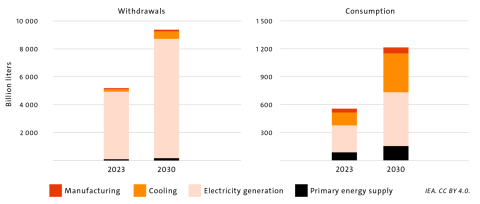
Data centres are expanding into the Gulf, raising a critical question: how can water-intensive AI infrastructure operate in one of the world’s driest regions? A 2026 study by UNU-INWEH projects that data centres’ water footprint could reach 9.3 trillion litres a year by 2030 , enough to meet the annual needs of 1.3 billion people in Sub-Saharan Africa. As Gulf states build large-scale data complexes in the desert, the environmental cost of powering AI is coming into sharper focus.

Credit : Fox Business ,May 13, 2025.
Gulf AI Boom: Where Will the Water Come From?
Donald Trump’s May 2025 visit to the Gulf accelerated plans for large-scale AI development in Saudi Arabia and the United Arab Emirates. The importance of AI to the talks was underscored by the presence of major tech leaders, including OpenAI CEO Sam Altman, Nvidia CEO Jensen Huang and xAI founder Elon Musk.
Their companies are investing billions of dollars in AI infrastructure and data centres across the Gulf. Two projects have emerged as major developments: Abu Dhabi’s Stargate AI project and the partnership between Saudi Arabia’s Humain and Nvidia.
But one question remains largely overlooked: how will Saudi Arabia and the UAE meet the enormous water demands of AI data centres? According to FAO’s 2024 Statistical Yearbook, Saudi Arabia and the UAE withdraw far more freshwater annually than their renewable freshwater resources can naturally replenish.
“Saudi Arabia and the UAE withdraw far more freshwater annually than their renewable freshwater resources can naturally replenish.”
The debate around Gulf AI development has instead focused on the promise of “sovereign AI.” Supporters argue that domestic AI infrastructure could transform public services, agriculture and water management. AI-powered irrigation systems, for example, could help distribute scarce water more efficiently.
Yet sovereign AI also has a strategic dimension. For Saudi Arabia and the UAE, control over advanced AI infrastructure could strengthen their technological and geopolitical position. The challenge is whether the Gulf can build that AI future without deepening its water crisis.
From oil wealth to AI power
The race for artificial intelligence is becoming a new global competition. Saudi Arabia and the UAE want to be among its leading players. Both are investing heavily in AI infrastructure, including data centres, GPUs and computing capacity.
For the Gulf states, AI is also about economic diversification. Their economies remain heavily dependent on oil exports and foreign investment. AI offers another strategic sector as they prepare for a post-oil future.
A key attraction is AI sovereignty. IBM defines it as a state’s ability to control key parts of the AI supply chain, or “AI stack,” including infrastructure, data, models, chips and governance.
No country currently controls the entire AI stack. The supply chain is too complex, particularly when it comes to advanced chips and computing hardware. Instead, countries seek to secure a position within it. The US and China currently dominate key parts of the global AI ecosystem, including advanced chips and AI models.
Saudi Arabia and the UAE are seeking their own place in this system. The UAE is positioning itself as a hub for US-backed AI data centres, while Saudi Arabia is building domestic AI capabilities through companies such as Humain, alongside US investment and technology.
This strategy does not make either country fully AI sovereign. Both remain dependent on foreign technology, investment and hardware. But by hosting infrastructure and developing domestic AI companies, they can gain greater influence over how AI develops in the region.
Why Data Centres Are Becoming Strategic Infrastructure?
AI is no longer just an economic technology. It is becoming strategic infrastructure. As governments integrate AI into public services, intelligence and defence, access to computing power, data and secure infrastructure is increasingly tied to national security.
The OECD identifies national AI compute capacity as a potential national security and sovereignty issue. Keeping computing capacity within a country’s jurisdiction can give governments greater control over sensitive data, infrastructure and AI systems, while reducing exposure to foreign disruption or cyberattacks.
The military implications are already becoming clear. NATO says AI is reshaping the defence and security environment and can support everything from situational awareness and intelligence to decision-making and operational autonomy. Its 2026 Digital Strategy calls for secure, resilient computing and data infrastructure capable of supporting military operations in contested environments.
This makes data centres more than warehouses for servers. They are the physical foundation that allows governments and companies to develop and run increasingly powerful AI systems. The International Energy Agency reports that AI-focused data centres have more than tripled in capacity over the past 18 months, highlighting the rapid expansion of the infrastructure behind the technology.
For Saudi Arabia and the UAE, building this infrastructure is therefore about more than attracting technology investment. It is also about securing a position within the emerging AI ecosystem. The World Economic Forum describes AI infrastructure as an increasingly strategic concern amid geopolitical tensions and growing dependence on computing and data storage.
But sovereignty does not necessarily mean self-sufficiency. Countries can still depend on foreign companies for advanced chips, software, investment and expertise. The strategic question is how much of the AI infrastructure a country can control , and how resilient that infrastructure is when geopolitical tensions rise.
Economic Race or Political One?
For Saudi Arabia and the UAE, the AI race is both an economic and strategic project. AI investment is part of their broader push to diversify beyond oil, attract foreign capital and build new technology sectors. The IMF estimates that AI could raise Saudi Arabia’s labour productivity by around 5 percent over the medium term. Across the GCC, generative AI could generate an estimated $21 billion to $35 billion a year, on top of the potential value created by other AI technologies.
The UAE is pursuing a similar strategy. The IMF says AI investment could support economic diversification, improve government efficiency, attract foreign investment and strengthen productivity in non-hydrocarbon sectors.
AI also has a domestic role. In Saudi Arabia, FAO backed projects are using smart irrigation systems, sensors and digital controls to improve water efficiency. The UAE is deploying AI-driven tools and real-time monitoring to optimise water and energy use, according to the IMF.
But the stakes extend beyond economic growth. Both countries are competing for AI talent, research capacity and technological influence. According to the IMF, the UAE and Saudi Arabia are attracting AI skills from abroad faster than the United States, although both still have a lower concentration of AI talent than the US. Saudi Arabia’s national AI strategy also aims to attract $20 billion in investment, train 20,000 data and AI experts and establish 300 active AI startups.
“Saudi Arabia’s national AI strategy also aims to attract $20 billion in investment, train 20,000 data and AI experts and establish 300 active AI startups.”
That makes AI an increasingly strategic asset. The OECD identifies national computing capacity as a matter of economic productivity, resilience, security and sovereignty. Control over computing infrastructure can give states greater capacity to develop and deploy AI within their own jurisdictions.
For Saudi Arabia and the UAE, the objective is therefore not simply to consume AI. It is to build a position within the infrastructure, talent and investment networks that will shape the technology. That could give the Gulf greater economic leverage and a stronger role in the emerging global AI order.
Why AI Needs Gigawatts of Infrastructure
AI may appear to exist in the cloud, but it runs on vast physical infrastructure. Data centres house the servers, storage systems and specialised chips needed to train and run AI models. GPUs are particularly important because they can perform the parallel calculations required by modern AI systems. The IEA estimates that servers account for around 60% of electricity consumption in modern data centres.
The scale of this infrastructure is growing rapidly. According to the International Energy Agency, a conventional data centre typically requires 10–25 megawatts (MW) of power. An AI-focused hyperscale facility can require 100 MW or more. The largest facilities under construction are reaching around 2,000 MW, while some planned projects could reach 5,000 MW.
“An AI-focused hyperscale facility can require 100 MW or more. The largest facilities under construction are reaching around 2,000 MW, while some planned projects could reach 5,000 MW.”
The chips themselves are also becoming increasingly power-hungry. IBM reports that advanced AI chips can require hundreds of watts per chip. Concentrating thousands of these chips in a single facility creates enormous amounts of heat that must be removed to keep the hardware operating safely.
That makes cooling a major part of the AI infrastructure equation. The IEA estimates that cooling systems can account for around 7% of electricity use in efficient hyperscale data centres and more than 30% in less-efficient facilities. High-density AI facilities are increasingly turning to liquid cooling because it can remove heat more efficiently than conventional air cooling. IBM notes that some liquid-cooling systems use water to transfer and dissipate heat.
“The IEA estimates that cooling systems can account for around 7% of electricity use in efficient hyperscale data centres and more than 30% in less-efficient facilities.”
The energy demand is already significant. Data centres consumed around 415 terawatt-hours (TWh) of electricity globally in 2024, equivalent to about 1.5% of global electricity consumption. The IEA projects that this figure could more than double to around 945 TWh by 2030, with AI as the main driver of the increase.
For the Gulf, this creates a particularly important infrastructure challenge. Building AI data centres means securing not only billions of dollars in computing hardware, but also reliable electricity, cooling systems and, where water-based cooling is used, access to water. In one of the world’s most water-stressed regions, the question is therefore not simply how much AI the Gulf can build , but how much energy and water it can devote to keeping that infrastructure running.
The Hidden Resource Behind AI: Water
AI may run on electricity, but it also needs water. Data centres generate large amounts of heat as servers and GPUs process AI workloads. Cooling systems are therefore essential to keep this equipment within safe operating temperatures. The amount of water required, however, depends heavily on the cooling technology and the climate in which a data centre operates. The International Energy Agency estimates that cooling can account for around 7% of electricity use in efficient hyperscale data centres and more than 30% in less-efficient facilities.
Water use is more complicated than asking how much water a single AI query “consumes.” AI’s water footprint can come from several stages, including cooling data centres and generating the electricity that powers them. It can also vary considerably between facilities.
Two terms are particularly important: water withdrawal and water consumption. Withdrawal is the amount of water taken from a river, lake, aquifer or other source. Consumption is the portion that is not returned to that source, for example because it evaporates or is transferred elsewhere. The distinction matters in water-stressed regions because consumed water is no longer immediately available to other users. The IEA uses this distinction in its assessment of water use across the energy sector.
For data centres, one important measure is Water Usage Effectiveness (WUE). It measures water use against the energy consumed by IT equipment, typically expressed in litres per kilowatt-hour (L/kWh). But there is no single water requirement for an AI data centre. Cooling design can dramatically change the amount of water consumed.
Evaporative cooling works much like sweating. Water absorbs heat as it evaporates, making the system relatively energy-efficient but potentially water-intensive. This can create a particular challenge in hot, water-stressed regions.
Direct-to-chip liquid cooling circulates a coolant directly to components that generate the most heat, such as GPUs. It can handle high-density computing more efficiently than conventional air cooling and can be designed as a closed-loop system to reduce water consumption.
Other technologies can reduce or eliminate freshwater consumption. Immersion cooling places servers in a non-conductive fluid that transfers heat away from the components. Dry cooling uses air and heat exchangers rather than evaporating water. Hybrid systems can combine liquid cooling for high-power chips with air cooling for other equipment.
This means that building AI infrastructure in the Gulf does not automatically require large quantities of freshwater. Data-centre operators can choose technologies that reduce water consumption or use alternative sources such as treated wastewater. But those alternatives come with their own technical and economic constraints.
Seawater is another potential option, particularly for coastal data centres. However, it presents engineering challenges, including corrosion and the need to manage salt and other contaminants. Using seawater or treated wastewater therefore requires specialised cooling and water-treatment systems rather than simply replacing freshwater with seawater.
The distinction is crucial for the Gulf. The question is not simply whether AI data centres use water, but which water they use, how much they consume, where it comes from and whether it can be returned to the local water system. In a region already facing severe water stress, those choices could determine the environmental cost of the Gulf’s AI expansion.
The Environmental Cost of Digital Sovereignty: Water, Energy, and Emissions Impacts of Sovereign AI Infrastructure in the Global South
Florida Institute of Technology, Melbourne, FL, USA, Daffodil International University, Dhaka, Bangladesh and UAE University, Al Ain, United Arab Emirates.
Energy is a major driver of AI’s indirect water footprint, with power generation accounting for a significant share of the water used and withdrawn across the data-centre supply chain. The chart below shows the scale of this water demand and its projected growth in the coming years.
The Paradox: AI Could Help Save Water While Consuming It
AI could become both a consumer and a conservation tool for water. Its data centres require water for cooling. But the same technology could help the Gulf manage its scarce water resources more efficiently.
In Saudi Arabia, a 2026 study indexed by the FAO found that AI-compatible smart irrigation and digital water monitoring were significantly associated with better agricultural water efficiency and productivity. The study examined 13 Saudi regions and six major crops between 2010 and 2024. Its authors stress that the findings reflect data-driven irrigation and monitoring rather than the direct impact of autonomous AI systems.
The potential is particularly significant in agriculture. FAO estimates that irrigation efficiency in Saudi Arabia is around 50%, compared with a global best-practice benchmark of about 85%. The country also relies heavily on non-renewable groundwater.
“FAO estimates that irrigation efficiency in Saudi Arabia is around 50%, compared with a global best-practice benchmark of about 85%. The country also relies heavily on non-renewable groundwater.”
Smart irrigation can use weather, soil and crop data to determine when and where water is needed. Saudi Arabia is already testing such systems. In a 2026 FAO-backed project, smart irrigation trials reduced water consumption by 19% in mango farms in Jazan, while greenhouse trials in Al-Baha saved about 24% of water.
AI could also support wider water management. FAO says AI applications in the region are being explored for water management, climate forecasting, land monitoring and resource optimisation.
But there is a crucial caveat. More efficient irrigation does not automatically mean less water is withdrawn. FAO‘s review of high-tech irrigation warns that documented evidence of actual water savings remains limited and that technology must be combined with controls on water extraction and allocation.
The Gulf therefore faces a paradox. AI infrastructure could increase pressure on already scarce water resources while also giving governments new tools to manage them. Whether the technology becomes a net benefit will depend not only on how efficiently AI uses water, but on how effectively its gains are translated into lower withdrawals, better irrigation and sustainable water management.
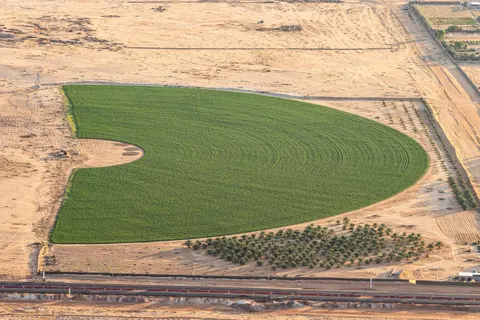
Credit: Forbes , Producing Profit In The Desert – Pure Harvest Enjoys Fruits Of Success
Why Location Matters: Building AI in One of the World’s Driest Regions
Location matters when it comes to AI infrastructure. Saudi Arabia and the UAE are among the world’s most water-stressed countries. FAO’s water-stress indicator measures freshwater withdrawals against available renewable freshwater resources, while accounting for the water needed to sustain ecosystems. Western Asia, where both countries are located, faces some of the world’s most severe water pressures.
Both countries have limited renewable freshwater resources and rely heavily on groundwater and desalination to meet demand. This makes the location and cooling technology of new AI data centres particularly important. A facility that relies on evaporative cooling could place additional pressure on freshwater supplies, while closed-loop, dry or alternative-water cooling systems could reduce that pressure.
Desalination has helped make large-scale urban development possible in the Gulf, but it comes with environmental and energy costs. Producing freshwater from seawater requires substantial energy, while the process also generates concentrated brine.
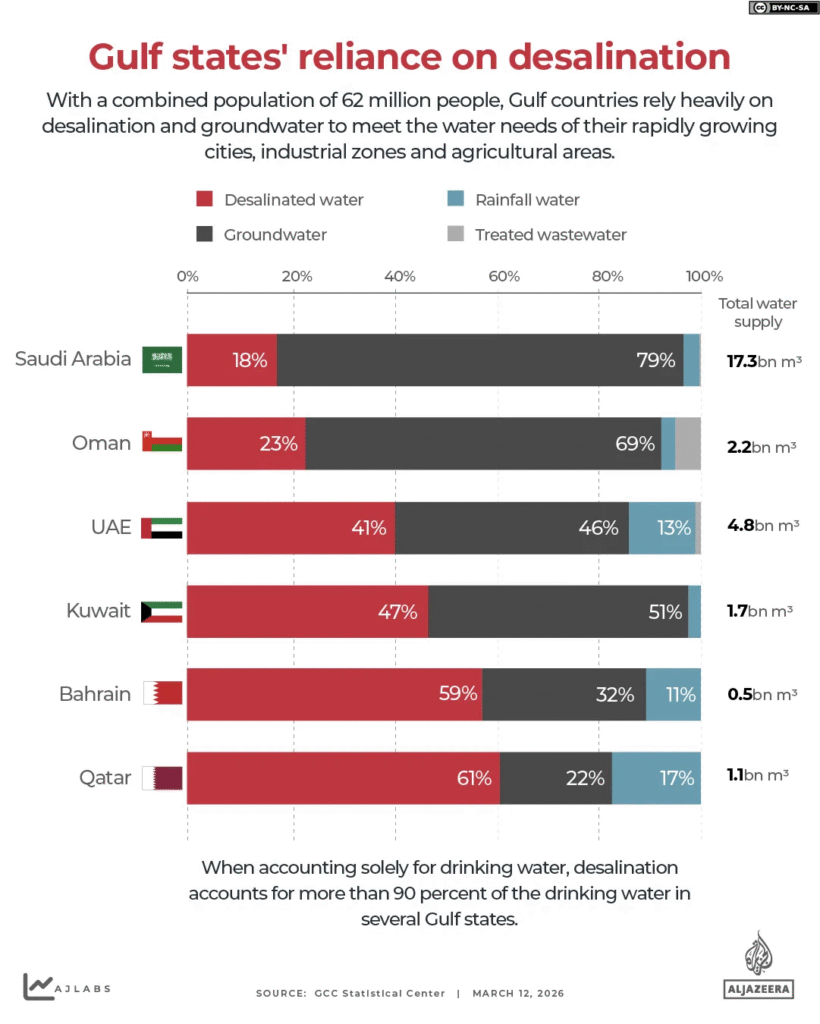
Credit : AlJazeera
A 2025 study led by researchers at Khalifa University, MIT and Yonsei University found that desalination capacity in the Arabian Gulf could increase more than sixfold by 2050. The researchers found that brine discharged from desalination plants can alter local salinity and ocean circulation, although the Gulf’s natural dynamics may limit the scale of some impacts.
“Desalination capacity in the Arabian Gulf could increase more than sixfold by 2050.”
Groundwater presents another constraint. Renewable groundwater reserves are limited in an arid region, and intensive extraction can lower groundwater levels and, in some settings, contribute to land subsidence. Adding a new industrial demand such as AI data centres could therefore intensify competition for already scarce water resources if freshwater-based cooling is used.
The challenge is not simply how much water AI data centres consume. It is where that water comes from, whether it is renewable, and what happens to it after use. In the Gulf, those questions are inseparable from the environmental cost of building an AI economy in one of the world’s most water-stressed regions.
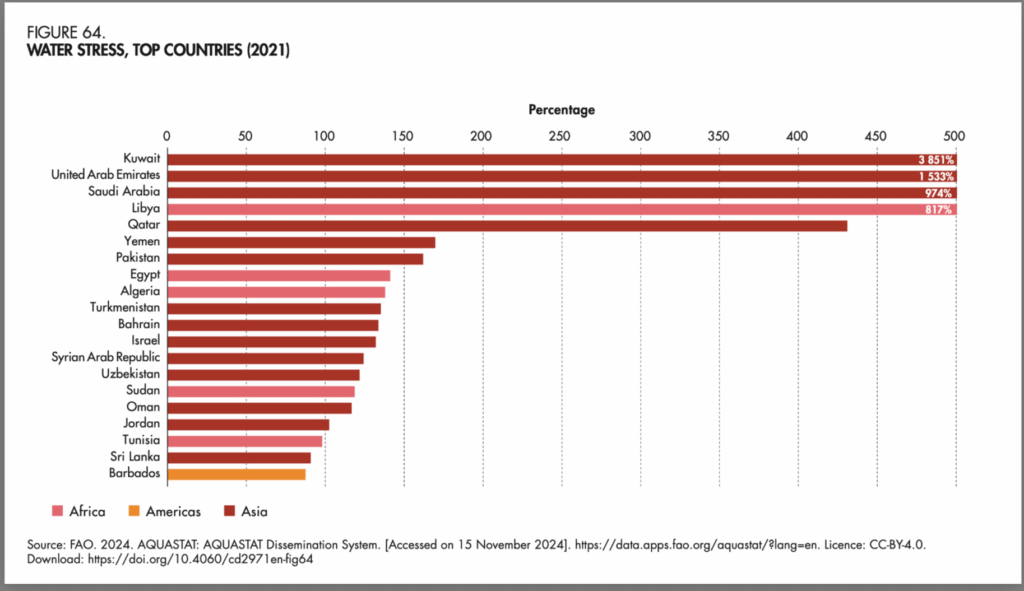
Credit : FAO
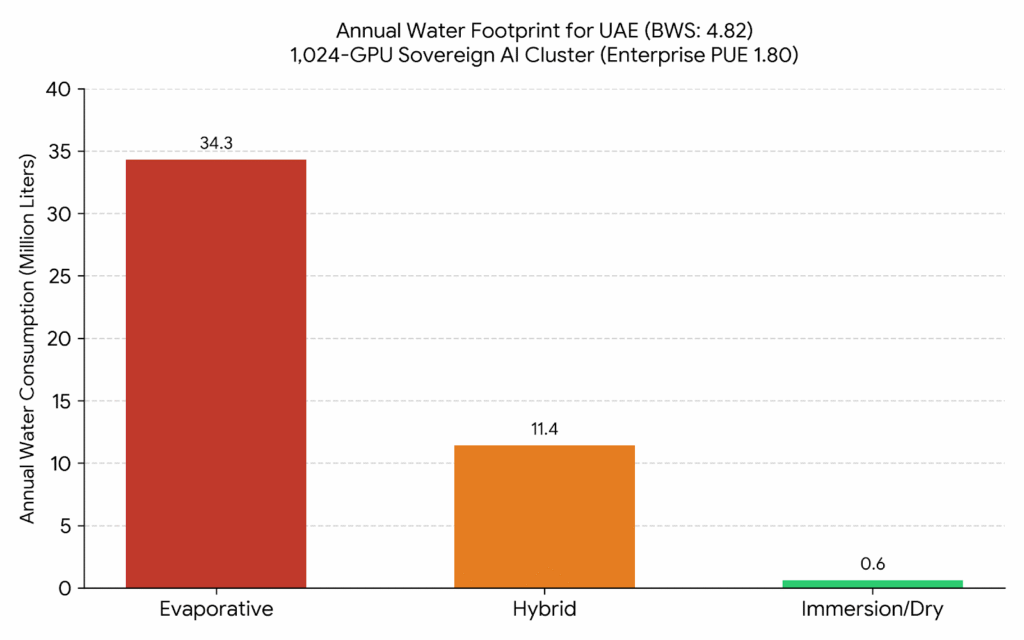
A 2026 modelling study of sovereign AI infrastructure in the UAE estimates that a hypothetical 1,024-GPU cluster using evaporative cooling could consume 34.3 million litres of water a year. That is roughly the volume of 14 Olympic-size swimming pools.
On a national scale, that may appear small. Against 4.8 trillion litres, it represents about 0.00071% of the annual water supply cited by the chart. But national averages can obscure local pressure. Large data centres can concentrate water and energy demand in specific locations, potentially intensifying competition with other users.
The bigger issue is the Gulf’s water-energy nexus. Water and electricity are tightly connected. Desalination and groundwater pumping require energy. Data centres require both electricity and cooling water. And the electricity used to power those data centres can itself carry an indirect water footprint through power generation.
The result is a three-way loop:
1. Water production: Desalination and groundwater extraction require energy.
2. Data-centre cooling: AI facilities can draw directly on desalinated, groundwater or municipal supplies.
3. Electricity demand: Data centres add to the power load, creating an additional indirect water footprint.
This makes the water footprint of AI more complicated than the litres consumed inside a data centre. It includes the wider infrastructure needed to produce both its water and electricity.
The UAE study illustrates how sharply cooling technology can change the equation. Under the same 1,024-GPU configuration, switching from evaporative cooling to immersion cooling reduced estimated annual water consumption from 34.3 million litres to about 0.57 million litres , a 98.3% reduction.
The water paradox is therefore clear. AI could help governments manage scarce water more efficiently, but the infrastructure needed to run AI can also increase demand for that same scarce resource.
Breaking the cycle will require more than smarter water management. Cooling efficiency, water sourcing and low-water electricity generation will all matter. Renewable power can reduce the indirect water and carbon footprint associated with electricity generation, but it does not eliminate the data centre’s direct cooling-water demand
The OpenAI Investment Question: Who Pays the Environmental Bill?
OpenAI’s Stargate project shows the scale of investment behind the AI boom. In January 2025, OpenAI and its partners announced plans to invest $500 billion over four years in AI infrastructure in the United States. In the UAE, OpenAI later announced Stargate UAE, including a 1-gigawatt AI cluster in Abu Dhabi, with 200 megawatts expected to come online in 2026.
But the financial investment is only one side of the equation. AI infrastructure also creates demands for electricity, cooling, land and water. The IEA estimates that data centres consumed 415 TWh of electricity in 2024, around 1.5% of global electricity use. It projects that global data-centre electricity consumption could reach about 950 TWh by 2030. AI-focused facilities are expected to account for a growing share of that demand.
“The IEA estimates that data centres consumed 415 TWh of electricity in 2024, around 1.5% of global electricity use. It projects that global data-centre electricity consumption could reach about 950 TWh by 2030.”
This raises a broader question for the Gulf: who pays for the environmental infrastructure that makes AI possible? Private companies finance data centres and computing equipment. But governments and utilities provide the wider systems they depend on: electricity grids, water networks, desalination capacity, land and other infrastructure.
The environmental bill therefore extends beyond the companies operating the servers. It can also fall on public infrastructure and local resources. In water-stressed regions such as the Gulf, the key issue is not simply how much OpenAI or another company invests. It is whether the environmental costs of that investment are properly measured, disclosed and accounted for as AI infrastructure expands.
Can the Gulf Build “Water-Smart” AI?
Building water-smart AI in the Gulf would require more than simply reducing the amount of water used by data-centre cooling. It would mean managing water, electricity and AI demand together.
Choose low-water cooling
Data centres can reduce freshwater demand through dry cooling, closed-loop liquid cooling and immersion cooling. They can also explore treated wastewater or seawater where technically and environmentally appropriate.
But cooling is only part of the equation. The electricity powering AI also has a water footprint through power generation. The 2026 UNU-INWEH report warns that reducing one environmental footprint can increase another.
Power AI with low-water energy
The IEA projects that electricity consumption from data centres will rise sharply this decade. Renewables such as solar and wind can reduce dependence on fossil-fuel generation. But “renewable” does not automatically mean “water-free”: the IEA and UNU-INWEH both stress that carbon, water and land footprints must be assessed together. For the Gulf, solar power is particularly relevant given the region’s exceptionally high solar potential.
Match AI to the task
Not every task requires a large generative model. The UNU-INWEH report finds that energy use can vary dramatically depending on the task and model. A typical conversational AI query can consume far more energy than a basic classification task, while image and video generation can require substantially more.
The report therefore calls for efficiency by design and demand-side guardrails. In practice, that means using simpler tools when they can do the job, and reserving resource-intensive models for tasks that genuinely need them.
The goal is therefore not simply to build less thirsty data centres. It is to build an AI system that uses less freshwater, cleaner electricity and only as much computing power as the task requires. In the Gulf, where water and energy systems are tightly connected, that distinction could determine whether AI expansion adds to resource pressure or becomes compatible with long-term water security.
The Question the Gulf Must Answer
The Gulf’s AI ambitions are no longer simply about how much computing power the region can build. They are also about whether that infrastructure can operate within its environmental limits. Saudi Arabia and the UAE are investing heavily in data centres, AI models and sovereign computing while facing some of the world’s most severe water pressures.
The central question is therefore not whether the Gulf can build AI, but whether it can build an AI economy without deepening its water and energy pressures. Water-efficient cooling, low-water electricity, recycled water and more efficient AI models can reduce the burden. But technology alone will not resolve the problem.
The environmental cost of AI will ultimately depend on how much infrastructure is built, where it is located, how it is powered and how its water is sourced. For the Gulf, building AI may be a strategic ambition. Making it compatible with long-term water security is the harder test.
Copyright © 2026 Blue Arabi. All rights reserved.